
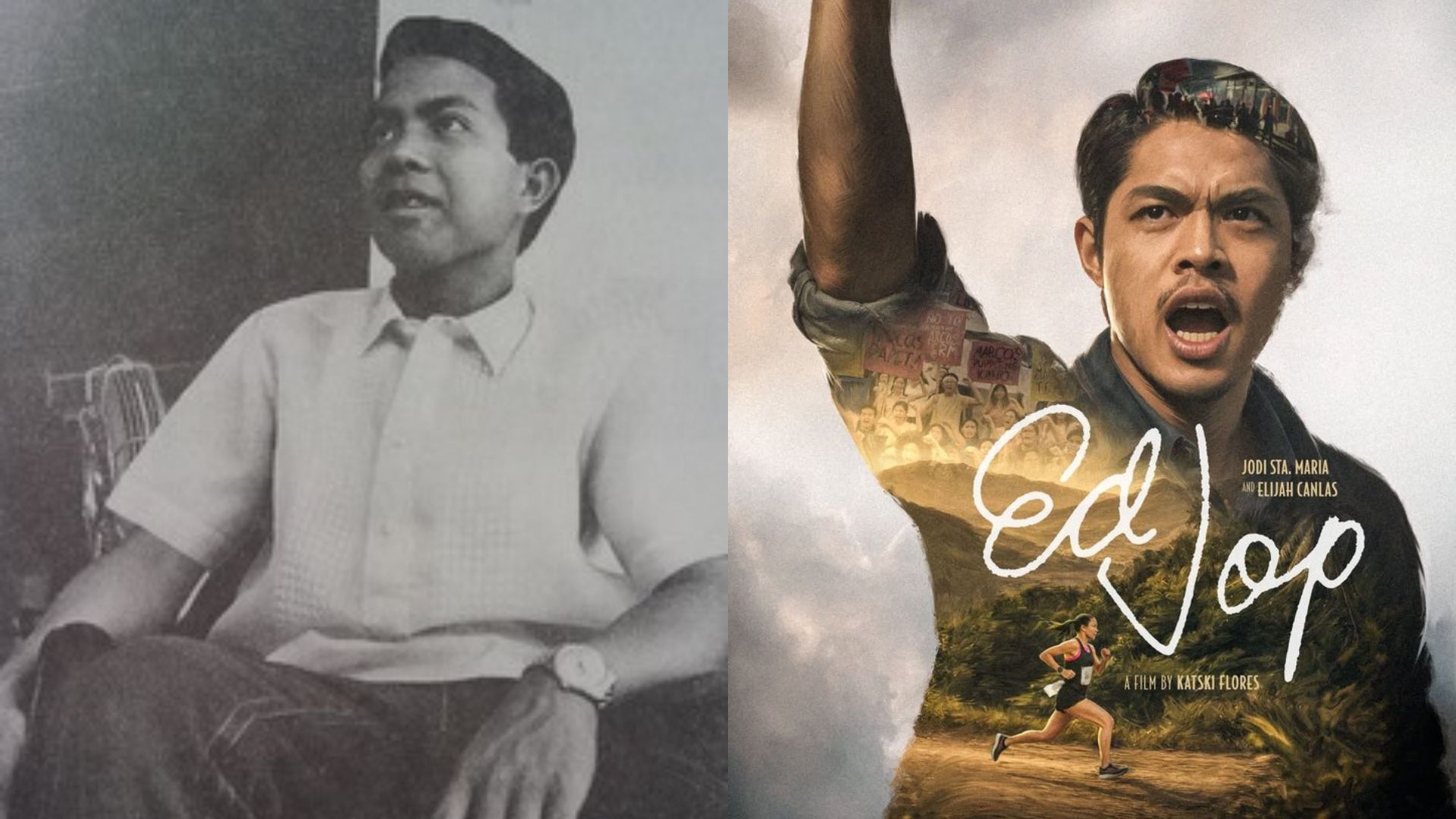
Decades after his death, the story of Edgar Gil “Edjop” Jopson, one of the most prominent student leaders before Martial Law, is returning to the spotlight through the film Edjop.
For many Filipinos, Edjop’s name is associated with the student movement that emerged during one of the country’s most turbulent political periods. But beyond the historical accounts, his life tells the story of a young Filipino who chose to speak up at a time when doing so came with increasing risks.
Jopson served as president of the National Union of Students of the Philippines (NUSP) in 1969, then the country’s largest student organization with members from 69 colleges and universities around the country. It was during this time when Philippine universities became important centers of political discussion. Students increasingly spoke out about poverty, government corruption, social inequality, and national sovereignty, and Jopson became one of the leading voices of this movement.
In 1970, he and other student leaders famously met with then-President Ferdinand Marcos at Malacañang, where the young activist reportedly challenged Marcos over government policies and the growing unrest among students. This encounter reflected the changing political climate: Filipino students were no longer simply participating in campus affairs—they were becoming an increasingly influential force in national politics.
Jopson’s activism coincided with the First Quarter Storm of 1970, a period of massive demonstrations and political unrest. Thousands of students and protesters took to the streets, demanding reforms and calling attention to issues affecting ordinary Filipinos. Then, the political situation became even more dangerous when Marcos declared Martial Law in 1972.
With opposition suppressed, media organizations shut down, and activists arrested, Jopson went underground and continued organizing against the dictatorship. But this resistance came at a tremendous personal cost.
Jopson was arrested in 1979 and reportedly subjected to torture. Using his wiles and strategic bribes to various guards and intelligence officers, Jopson managed to arrange a transfer for himself to the safe house of Rodolfo Aguinaldo—a rebel-hunter for Marcos, who believed he could use Jopson as an informant for the underground movement. Seizing the chance, Jopson maneuvered past the guards during his transfer and escaped, returning to the underground movement rather than abandoning his opposition to the regime.
In his final years, Jopson continued to work for the movement, and in 1982, he was captured again during a military raid. He was shot, taken alive for questioning, and executed for refusing to cooperate. He was only 34 years old.
More than four decades after his death, Jopson’s story continues to resonate among Filipino. His life was not simply defined by his role as a student leader, but was also shaped by his decision to remain involved even when political dissent became increasingly dangerous.
With Edjop coming to Philippine cinemas, a new generation will have an opportunity to encounter his story through film. The movie arrives at a time when conversations about history, memory, and the experiences of Filipinos during Martial Law remain important. Jopson reminds us that history is also made by young people who choose to speak, organize, and stand by their convictions—even when the consequences are immense.